
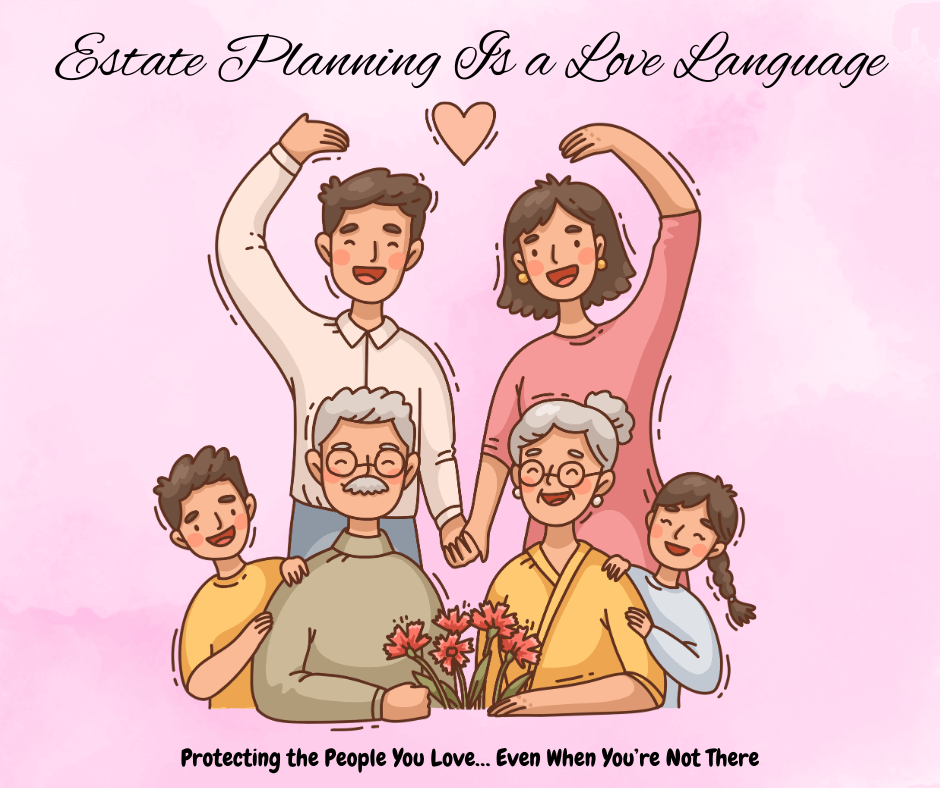
 We all have different ways of giving and receiving love, and those preferences can reveal a great deal about us.
You may be the type who expresses love with words, telling people you care about them or crafting carefully worded messages for someone when they need encouragement. Or maybe you prefer physical affection such as hugging and holding hands to show how you feel. Others express love through gifts: flowers, perfectly chosen birthday presents, or a surprise spa day. For many, love dwells in shared moments or in quiet, selfless acts that make someone else’s life easier.
How we express our love for others and how we prefer to have love shown to us is known as our love language. We may speak one love language when we give love and another when we receive it. Depending on our personality, our expressions of love can be far-reaching and obvious or small and subtle.
Estate planning is a love language all its own that can communicate care not only through gifts of money and property but also through the act of planning for what will eventually happen to us. It is a way of showing love to the people who depend on us by creating clarity and support so that they are not left guessing or scrambling when we are no longer here.
The Estate Planning Paradox: Some Ideas Remain Off-Limits
The idea of different love languages has become shorthand for how we show care, responsibility, and emotional investment in the people who matter most to us—all themes that also fit naturally with estate planning.
However, while self-help, emotional openness, and the love-language framework now seem part of a ubiquitous cultural movement toward emotional fluency, talking about death and estate planning continues to be substantially taboo. Most people still avoid discussing the following topics:
- who will care for them
- how they want to die
- how they want their assets to pass
- family expectations and responsibilities
- long-term care needs
- future burdens placed on their children or partners
Even emotionally fluent individuals and families often avoid end-of-life conversations because they may feel morbid or triggering. Research has found that parents and their adult children often avoid talking about topics such as medical decision-making, long-term living arrangements, and future burial plans.
Another study revealed that death and estate planning ranked as the second-most-difficult topic to discuss with family.
We may have become more expressive about our feelings in life but not about what happens after life.
Admitting that you may someday lose your independence clashes with our cultural emphasis on self-determination and autonomy, forcing us to confront a potential loss of control—a situation our culture is uniquely uncomfortable with.
How Each Love Language Shows Up in an Estate Plan
Emotional transparency, it turns out, has its limits. Even though openness is demonstrably higher than it has ever been in our culture, estate planning rates remain frozen in time and, by some measures, are lower than ever.
The irony is that estate planning can communicate care more powerfully than many of the love languages we use each day. Consider how each love language may show up in your estate plan.
Words of Affirmation: Clear, Considerate Communication About Wishes
Estate planning, with its legalese and technical terminology, can seem unapproachable. At the simplest level, though, an estate plan is a set of documents that communicates meaning and intentionality. Words of affirmation result when someone
- talks openly with family members about their values and intentions;
- tries to reduce confusion or hurt by explaining why they made certain decisions; or
- leaves instructions that make loved ones feel respected and remembered.
Estate planning parallel: People want to feel seen, valued, and emotionally safe. Estate planning gives your loved ones the reassurance of knowing exactly what you want and why. It removes ambiguity—the emotional friction that often leads to hurt or conflict—and shows them that they are appreciated and protected.
Acts of Service: The Planning Process Itself
It is not a stretch to say that estate planning is an act of service built on performing helpful, thoughtful deeds such as the following:
- handling difficult decisions about your healthcare, incapacity, and end-of-life preferences ahead of time
- protecting vulnerable beneficiaries
- organizing information necessary for estate administration in a simple, followable format
Estate planning parallel: People feel loved when someone reduces their load, especially during moments of stress and uncertainty. A well-designed estate plan quietly shoulders future legal, financial, and emotional burdens so your family does not have to carry them in the hardest moments.
Documents that speak this love language:
- Financial powers of attorney that empower someone to manage your financial affairs
- Healthcare powers of attorney that designate trusted medical decision-makers
- Remembrance and services instructions that spare your loved ones immediate logistical stress
Gift Giving: The Legacy You Purposefully Design
An estate plan is not merely about money and gifts, but it does involve a strong element of gift giving. In this case, the giver is leaving their most valuable assets and prized possessions to family, friends, and charities, reinforcing relationships and building emotional bonds with tangible items. The love language of gift giving can be seen in
- choosing who receives your most treasured personal items and charitable gifts;
- funding education or setting up long-term support for your children, grandchildren, or other loved ones; and
- ensuring that your assets transfer smoothly through proper titling and designations.
Estate planning parallel: People want to feel remembered and cherished. Planning turns inheritance into meaning and elevates gifts to something more than material transfer. Whether it is money, a family heirloom, or a charitable gift, it communicates “this mattered to me, and so do you.” The way assets pass under a solid estate plan—clearly, legally, and efficiently—is also its own gift.
Documents that speak this love language:
- Specific bequests in a will or trust for sentimental items or family heirlooms
- Charitable gifts or foundations that carry personal meaning
Quality Time: Planning That Preserves Time, Memory, and Connection
Quality time is about presence and togetherness. Think of moments from your life that have the greatest meaning. They were probably not spent alone; rather, you shared them with others, which is usually why they mean so much. Our time is limited, and how we spend it speaks volumes about what (and whom) we care about. Quality time in an estate plan looks like
- reducing conflict so that your loved ones can grieve and support one another;
- making end-of-life decisions in advance, preventing rushed or painful choices; and
- creating opportunities for future generations to connect (e.g., family trusts with shared purpose).
Estate planning parallel: People want to feel connected and prioritized. A well-organized estate plan gives your loved ones the time and emotional space they need to console, remember, and be together without distraction.
Documents that speak this love language:
- Guardianship designations that provide clarity and protection for children
- Well-structured trusts that minimize disputes and promote harmony
- Probate-avoidance tools (such as beneficiary designations or transfer-on-death arrangements) that simplify administration and free up emotional space
Physical Touch: Security and Protection When You Cannot Physically Be There
Physical contact builds and reinforces emotional bonds. Psychologically, it represents protection, security, and comfort, which most people need to feel loved. When you are physically incapacitated or gone, estate planning can play a deeply symbolic role that reinforces the power of human touch. Even when you are not physically present, estate planning mirrors the love language of physical touch through
- choosing trusted agents who will advocate for you;
- long-term care planning that shields your loved ones from overwhelming caregiving responsibilities; and
- life insurance and other financial protections for the future, which offer a kind of metaphorical embrace.
Estate planning parallel: Planning provides protection at a moment of great vulnerability. Medical directives, care instructions, and trusted decision-makers form a protective boundary around your loved ones, helping them feel safe and grounded and conveying an emotional steadiness they can feel even in your absence.
Documents that speak this love language:
- Medical directives and living wills that ensure that your care aligns with your wishes
- Trust provisions for disability or incapacity that create a protective framework for ongoing support
Translate Your Love Language into Planning Actions
We can help translate the love languages of the people who matter most to you into the language of estate planning with documents that reflect your voice, protect your legacy, and communicate care in a way that your loved ones will feel for years to come.
Posted in: Estate Planning, Gifting, Legacy, Trust